

My NordicTrack Reformer Review, As A Trained Pilates Instructor

Good Gear editors endorse products we’ve personally researched, tested, and genuinely love. Learn more about our methodology and business model here.
GOOD GEAR RATING — 8/10 STARS
Summary: The NordicTrack Ultra 1 Reformer makes at-home reformer Pilates possible, with a compact frame, a big screen for on-demand classes, and feedback on your form. Once you get the hang of the buttons and footbar, it’s an easy way to practice every day — whether it’s for an hour-long workout or a short stretch. It’s a beautiful, futuristic machine that has a smaller footprint than a traditional reformer.
What I Love:
- The Ultra 1 is compact, fits neatly into a small space, and feels safer and less technical for at-home use and beginners
- It connects to iFIT, so you can access a library of quality reformer workouts, and during the classes, the instructors tell you when to change the springs and move the footbar
- Built-in speakers let you hear the instructor from the carriage without headphones
- Smart Spine tracks your form in real time, so you can make adjustments easily on your own
Things To Note:
- If you’re used to a more classic reformer, expect a few sessions to get comfortable with button springs and footbars you pull up to shift
- The carriage runs short, so taller users (around 5’6″ and up) may want a larger model
- At $4,999.99, it’s a big investment and The iFIT app is an extra $39 on top of the machine
- With no middle to the footbar, some classic moves, like Mermaid, take a little creativity
As a competitive dancer growing up, my body developed by way of ballet. Twice a week, I’d stand at the bar in pink tights and a black leotard with my hair slicked into a tight bun. We’d go through a series of exercises, all named in French, pointing and flexing our feet, carefully working each muscle group in our legs, keeping our stomachs engaged and our shoulders down. Today, I owe my good posture to ballet, and my body still craves this style of movement — so when I took my first Pilates class after college, it felt like second nature.
“I owe my good posture to ballet, and my body still craves this style of movement — so when I took my first Pilates class after college, it felt like second nature.”
At first, I just took random mat Pilates classes on ClassPass, mostly taking advantage of new client specials, bopping around to different teachers. I didn’t think much about what “Pilates” meant, kind of assuming it was all the same — or even a more strength-focused version of yoga (which is absolutely not true). Until, in 2023, I started taking reformer and mat Pilates classes at Sapphire Pilates in Los Angeles, with my now dear friend Justine, who owns the studio. I realized within 10 minutes of my first class with her that even though I was a strong mover, I actually didn’t know what Pilates was at all. I might have looked good doing the moves, thanks to my ballet training — but I was doing a lot of them incorrectly. I didn’t know what a “neutral spine” was (a Pilates term you’ll learn!), or how to do it. I quickly learned that Pilates was an entire language. It was, in fact, “a practice,” and one that benefits tremendously from consistency.
Each time I went to the studio, I learned something new, and slowly started cultivating the body awareness to self-correct in different movements. I loved diving into this new universe, so I signed up for a 500-hour teacher training with Justine to learn everything I could. And as luck would have it, a week before the training started, I ended up moving right behind the studio, so I had no excuse not to practice.
Since that first class in 2023, I’ve taken no less than 400 classes…and have become a bit of a Pilates snob. I now understand the terminology, the different types of equipment, and actually have a strong opinion on whether or not a class is any good. I have a few teachers who I LOVE in Los Angeles — but recently, I’ve been spending most of my time in the desert with my boyfriend. Sadly, there aren’t many studios, and my movement practice has suffered. So when I had the chance to review the brand-new NordicTrack Ultra 1 Reformer at home, I jumped on it. And my boyfriend’s former meditation room just became a Pilates studio.
“A reformer is a big machine, with a footbar, springs, a carriage, shoulder blocks, and straps, that can be configured in a million different ways for resistance-focused exercises.”
For those of you who are new to Pilates, a reformer is a big machine with a footbar, springs, a carriage, shoulder blocks, and straps that can be configured in a million different ways for resistance-focused exercises. Reformers you’d find in a studio usually have a big rectangular frame with exposed springs in the front and a well in the back.
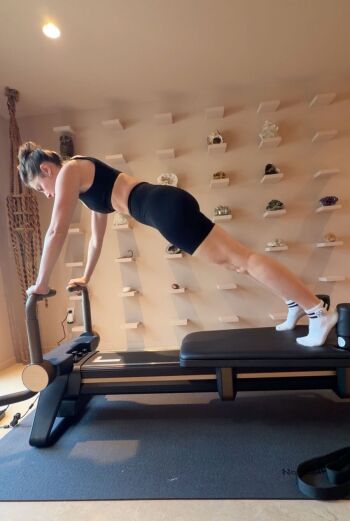
The NordicTrack Ultra 1 Reformer is compact and frameless, one solid piece, with a bar running down the middle covering the springs and the straps. It definitely feels futuristic — minimal, luxe, with a big screen affixed to the front, so that you can watch and follow along with workouts. If you’re used to a classic reformer, there is definitely a learning curve — but the design definitely has less of a footprint, and feels safer and less technical for at-home use and for beginners.
The sleek design also made the delivery super easy, as there were only two pieces to bring inside and nothing much to configure. All you need to do for assembly is lift the touchscreen in place and plug it in. I got the white-glove service, and two delivery men carried it into the house, and through the sliding doors without a problem. I’d recommend positioning the side with the screen closest to an outlet, as that’s where it plugs in.
“To my delight, I was taking a class just minutes after it arrived!”
I got the “Ultra Upgrade Package,” so it also came with some accessories: A big black mat that the reformer sits on, a headrest that comes on and off, a Pilates box, and a detachable jumpboard. And to my delight, I was taking a class just minutes after it arrived!

The first thing I noticed about the machine was the springs — or lack of visible springs. These are the mechanisms you use to control the resistance during your workouts. Instead of the typical five exposed springs I’m used to (three reds, a blue, and a white), it has three springs that look more like pegs with buttons on the top (red, green, blue). I looked up the spring weights, which NordicTrack calls “resistance controls.” Here they are for reference:
- Green 22 lbs (10 kg)
- Blue 33 lbs (15 kg)
- Red 44 lbs (20 kg)
Once I had a sense of what I was working with, the question was how to change them since they don’t hook on and off like I’m used to. When the buttons are down, all the resistance is engaged. When the buttons are up, they are off. A mix of up and down creates different weights. When you need to change them, you have to sit on the carriage, with your weight toward the front to pull them up or down. You can’t change them while you’re standing up, you need to be bearing down on the carriage, which I assume is for at-home safety — and it works once you get the hang of it!
In front of the springs is the footbar. But instead of a one-piece bar that you might find at a Pilates studio, it has two split footbars that move into four positions — more like a Megaformer. They move forward and backward, and the handles turn inward to face the machine too. To shift the footbar, you have to be pulling up — which took me a few days to figure out. They are easy to grip in a plank, and put your feet on for bridging exercises or footwork. It’s also nice that they turn totally out of the way if you want to stand on the platform and do lunges on the carriage. However, since there is no middle of the bar, you have to get creative doing moves like Mermaid, since you can’t grab the bar in the middle. Beyond the great library of classes on the screen (which we’ll get to soon!), I also did two Zoom private sessions with two different teachers, and we had to work around the uniqueness of the reformer to do some more traditional Pilates moves. It’s totally doable, but something to note!
Then there’s the carriage. This is the soft leather bed that you lie, sit, or stand on — it glides back and forth on the center part of the frame. The first thing I noticed about it is that it’s shorter than I’m used to. So when I lie on my back, with my head between the shoulder blocks, my butt is close to the end of the carriage.
I’m 5’5″ and it works for me, but it feels tight to put your feet on the platform or footbars when the carriage is all the way pulled in. If you take the shoulder blocks off, it gives you a little more room, but then you have no shoulder support. I’m bummed about this, because my boyfriend is 6’4″ — so it’s too tight for him to use for any moves where you lay on your back. I would suggest, if you’re 5’6″ or above, you’ll want to size up to the bigger machine that has a longer carriage — the Ultra 1 Reform RX works for heights up to 6’7″.

As for the shoulder blocks, they are plush and rounded, and come on and off easily — maybe even too easily. I found them wiggling a lot, and if I grabbed onto them while I was lying on my back (think the Short Spine move, if you’re a Pilates nerd), I would accidentally pull them off. Luckily, the carriage also has two handles behind them that you can grab to avoid this. Maybe it’s my preference, but I also prefer rectangular blocks where you can wedge your foot up against them for lunges instead of the round shape.

While all parts of the reformer are intentional and unique, the showstopper is the attached TV screen that moves on a swivel arm so you can join virtual Pilates classes. It connects to iFIT, an app that has tons of pre-recorded workout videos, including 75+ reformer Pilates sessions with great instructors. It connected seamlessly to my Wi-Fi by scanning a QR code and connecting it through the iFIT app on my phone. Keep in mind that it costs $39/month for the app, so that is an additional expense you’ll incur to be able to follow the Pilates classes.
No matter what level you are, or what your focus is, they have a class that will meet your needs. And throughout the pre-recorded classes, the instructor prompts you to change the springs and move the footbar, so you don’t have to figure that out on your own. There is also an indicator that stays live on the screen, telling you what settings your reformer is on. What I love is that you don’t need to wear headphones, as there are two premium built-in speakers on the back of the machine — so even if you’re lying with your head far away from the TV, you can hear the instructor’s prompts.

One of the real innovations on this machine is the Smart Spine™ Real-Time Feedback. Pilates is all about spinal alignment, first and foremost — and this feature measures real-time biometric data to report on your form and estimate the calories you burned during your workout. In the iFIT app, there’s also an “AI Coach” that serves as your personal fitness assistant to help you create a custom plan based on your goals and hold you accountable — I’m looking forward to using it to help me build a more consistent routine.
At $4,999.99, a reformer is a real investment. But with private Pilates sessions averaging around $100, 50 sessions a year already adds up to nearly that amount. With one at home, you can take as many classes as you want, at times that fit your schedule, without the drive. Saving time is saving money, in my opinion. I love that I can fit classes in around meetings, without having to conform to someone else’s schedule. They also offer financing options, with payments starting at $129 a month.
Lastly, moving to the back of the machine, the rear handgrips, “poggles” as they call them, are the two things sticking out of the back of the machine. These can be used for exercises like lat pulls if you kneel backward on the carriage, and coming out of them are the straps. These stowable cables are on a pulley and can completely retract for storage — which feels unique to NordicTrack. On the ends of the straps are a short and long loop, like any other standard Pilates reformer — they work great for a seated arm series. Walking into the meditation room every morning to do some stretching with my feet in straps is now my favorite way to start the day!
Everyone who has come over is astonished by how cool this machine is! And the other night when I got up to go to the bathroom, I walked by the meditation room to see it glowing — I didn’t realize there are lights underneath the machine — yet another thoughtful feature. Overall, this is a very well-made, intentionally designed machine that makes doing reformer Pilates at home actually possible, and more accessible. It takes up a small footprint in the room, and isn’t an eyesore like other workout equipment — which is a total bonus!
Your health is your number one asset — and daily movement is a huge part of that. Even 10 minutes of gentle stretching on the reformer every day makes a difference. I’m so grateful to have the NordicTrack at home, and can’t wait to explore its endless features and workouts!
This story is in partnership with our friends at NordicTrack.
Grace Abbott is a LA-based freelance Brand & Marketing Strategist and a Contributing Editor at The Good Trade. She has a degree in Graphic Design from Parsons School of Design and is the founder of How To Go Freelance — a brand dedicated to empowering creatives to monetize their skills and build personal brands. Beyond work, she’s always studying a new spiritual modality, painting her bedroom a new color, practicing Pilates, hosting friends, or going on a nature walk with her chihuahua, Donnie. Find her on Substack or Instagram.


