

Is AquaTru The Last Water Filter You’ll Ever Buy? 2026 Review

Good Gear editors endorse products we’ve personally researched, tested, and genuinely love. Learn more about our methodology and business model here.
GOOD GEAR RATING — 8/10 STARS
Summary: I sought out AquaTru after discovering lead in my apartment’s water — which can only be removed with a reverse osmosis filter like AT, After two months of testing, I’m happy with the AquaTru system. AquaTru water tastes great, doesn’t take up too much space under the sink, and had a pretty straightforward installation. I consider myself generally pretty handy, but I ended up getting professional help installing for peace of mind drilling into the existing pipes.
What I Love:
- AquaTru’s Under Sink filter holds plenty of water for one or two people. I’ve never run out of water while using the filtered water tank for drinking and filling my humidifier tank.
- It offers more peace of mind compared to a Berkey, which is great, but generally should be checked with a dye test regularly.
- Water in NYC can smell and taste like chlorine sometimes — which the Aquatru completely removes.
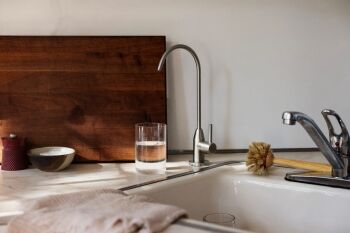
- I love the convenient spout!
Things To Know:
- Despite the remineralization filter, the water generally tastes flat. You’ll want to use remineralization drops.
- The tank does take up storage space under my sink in a small NYC apartment, but I prefer that over using counter space like my previous Berkey filter.
- I consider myself pretty handy, although I did not feel comfortable drilling into the pipe of an older building, so I ended up hiring a TaskRabbit. It only took the tasker about 30 minutes to install. If you’re a renter, note that this will involve drilling a hole into your countertop.
- The different filters need to be removed at different times (6 months, 1 year, 2 years or depending on the gallons run through).
I started looking into reverse osmosis systems after investigating my water quality in my New York City apartment. My shower filter was clogging quickly after replacements, leaving dark sediment. I sent the filter pad off to a geologist that I know, and the lab results showed very high concentrations of lead solids. Typically, lead is measured in dissolved parts per billion, but in this case we tested the weight of the solids in the pad. Because of the results, he told me not to drink or cook with the kitchen sink water, assuming it has the same amounts of lead.
“After researching public city databases, I found that some NYC buildings still have lead service lines, including my own building.”
After researching public city databases, I found that some NYC buildings still have lead service lines, including my own building. Supposedly, lead doesn’t absorb through skin, so I quickly moved on from the shower water to assessing the kitchen sink water. I had been using a Berkey filter for years for drinking water, which I loved but required upkeep and did not hold enough water.
The same geologist then sent me a water-testing kit to measure dissolved lead (not solids, like the test for the shower filter pad) in the kitchen sink. I doubled down and got a lead test from the city as well, which you can request for free through DEP. Surprisingly, the dissolved lead numbers in both tests came back 1-2ppb. Typically, above 5 ppb is cause for action, although of course no level of lead is good.
Lead testing kits require a “first draw,” which is the first water that comes out of the tap after not running water overnight, and then a “second draw,” which is 1-2 minutes later after running the water. Even if you have lead pipes, running the water for a bit before using it helps get rid of the stagnant water.
After all the testing, I decided I needed to upgrade my drinking water system from my Berkey (which also should remove lead).
“After all the testing, I decided I needed to upgrade my drinking water system.”
My filters were old, and to ensure a Berkey is working correctly, you should do a dye test, which I just couldn’t keep up with. Instead of investing in new Berkey filters, I wanted to ensure my drinking water was lead-free without hassle.
What should you know about reverse osmosis water filters?
Reverse osmosis systems can remove up to 99% of impurities. Water is filtered through a membrane that can remove contaminants at 0.0001 microns. These membranes have become more advanced over time, originally made from cellulose acetate in the 50’s until TFC came around in the 70’s. TFC (think film composite) is a multilayered approach with various materials for more effective filtering and is still the standard today.
Under-sink RO Systems are generally considered the most effective for filtering out contaminants like PFAS, nitrate, and chromium-6, compared to counter or refrigerator systems.
AquaTru started by inventing the world’s first countertop RO system — making quality water more accessible to everyone. They have since expanded to under-sink systems, pitchers, and shower filters. The brand is under the Ideal Living umbrella, which also makes AirDoctor air purifiers. They have been in business for over 20 years. AquaTru filters are independently tested by IAPMO (International Association of Plumbing and Mechanical Officials), showing the filters are certified to NSF (National Science Foundation)/ANSI standards.

Installing my AquaTru Under Sink filter
When the AquaTru came to my door, I popped open the box and found that all of the parts were organized inside. I took everything out and placed it on the rug in front of the sink, thinking I’d give the installation a go myself. It’s not too complicated — switching off the water and creating an offshoot for the filter — but given my pipes are old and disorderly, I ended up hiring a TaskRabbit to install. I figured it would take me 1.5–2 hours — and it took Dmitrii 30 minutes. He had installed many RO filters and learned via YouTube. He had no problem.

We were a step ahead, as there was an existing spout under the sink dating back 20 years. I easily removed the (very) old previous system that had not been used in decades to make room for the AquaTru system. There was a residual and subtle “blubbering” noise from the sink drain and lowered cold water pressure, which ended up being from air. The new line was not sealed with plumber’s tape. I ended up removing it and reattaching it with some plumber’s tape, and the blubbering and water pressure problem stopped.
“The first 1–2 days, the water had a slight chemical or odd taste, but after that it tasted great.”
Once the filter is installed, you have to fill and then fully empty the tank 3 times. This can take a while. The first 1–2 days, the water had a slight chemical or odd taste, but after that it tasted great, especially compared to the taste of city water and chlorine.
Having the spout is convenient and space-saving compared to the Berkey. I blind-tested two people on the first day of the filter with tap and Aquatru filtered water. Both preferred the tap water on that first day, but now prefer the filtered water.
My review of the AquaTru Under Sink filter
The AquaTru had two major impacts: Eliminating any chance of lead in my drinking water and freeing up coveted NYC apartment countertop space.
Everything I drink or cook is with the filtered water, and I use it to fill my humidifier tank. After the initial installation, the funny taste wore off, and I did notice the lack of what I suspect to be minerals made a difference in my coffee, especially. I was using a set of filters from AquaTru that remineralize the water, but was still finding it different than what I experienced from my Berkey. I’ve since purchased mineral tabs that I occasionally add to the water for flavor.
The AquaTru Under Sink system is $395. There is a 30-day money-back guarantee and a 1-year manufacturer’s warranty. Other undersink systems come in around the same price, with the smart filters closer to double.
“The AquaTru had two major impacts: Eliminating any chance of lead in my drinking water and freeing up coveted NYC apartment countertop space.”
Since I’m cautious about my water, I will probably overestimate how much water I use and end up replacing the filters prematurely. AquaTru’s site mentions visual and audible signals when it is time to replace a filter, but I haven’t quite figured that out yet. Replacing all of the filters is around $100, but they need to be replaced at different times — one usually at 6 months, another at 1 year, and another every 2 years. That ends up being $25 here, $35 there. In retrospect, investing in a smart RO system might make me more confident about what I’m spending to maintain it.


But, overall, the AquaTru is a great system for anyone wanting to upgrade their countertop or pitcher system. The undersink RO system provides me much more peace of mind. It’s not for you if you have zero under-sink space to spare, or are unable to drill a hole in your rental countertop, but otherwise it functions well and I rarely have to think about it.
“The AquaTru is a great system for anyone wanting to upgrade their countertop or pitcher system.”
The AquaTru is a good match for me now. I trust the water I’m drinking per NAF standards — no more spirals about what’s leeching into my water from old pipes! — and the price point is within range of other similar systems. It’s certainly an upgrade in space, time, and ease from my previous Berkey. And now that I have the hang of remineralizing my water, the taste is great.
Ashley D’Arcy is the Senior Editor at The Good Trade. She holds an MA in Philosophy from The New School for Social Research and has contributed to esteemed outlets such as The Nation, 032c, and Yale School of Management’s Insights where she’s leveraged her expertise in making complex ideas accessible to a broad audience. In addition to her editorial work, she is training as a psychoanalytic mental health professional and provides care to patients in New York City. Ashley also explores sustainable fashion, clean beauty, and wellness trends, combining thoughtful cultural critiques with a commitment to mindful living.


